
Red light used to belong in tanning salons and sci-fi movies. Now it sits quietly in bedrooms, home gyms, and bathrooms across America, glowing away while someone scrolls their phone or stretches their hamstrings. That shift didn’t happen by accident. Dermatologists started noticing real changes in patients who used these panels consistently, and skincare brands took notice too.
But here’s the catch: not every panel on Amazon does what it claims. Wavelength matters. Power output matters. Even the distance you sit from the device matters. In this article, we have pulled together expert insight and real buyer feedback to find the five Best Full-Body Red Light Therapy Panels that are actually worth your money, starting with the strongest overall pick.
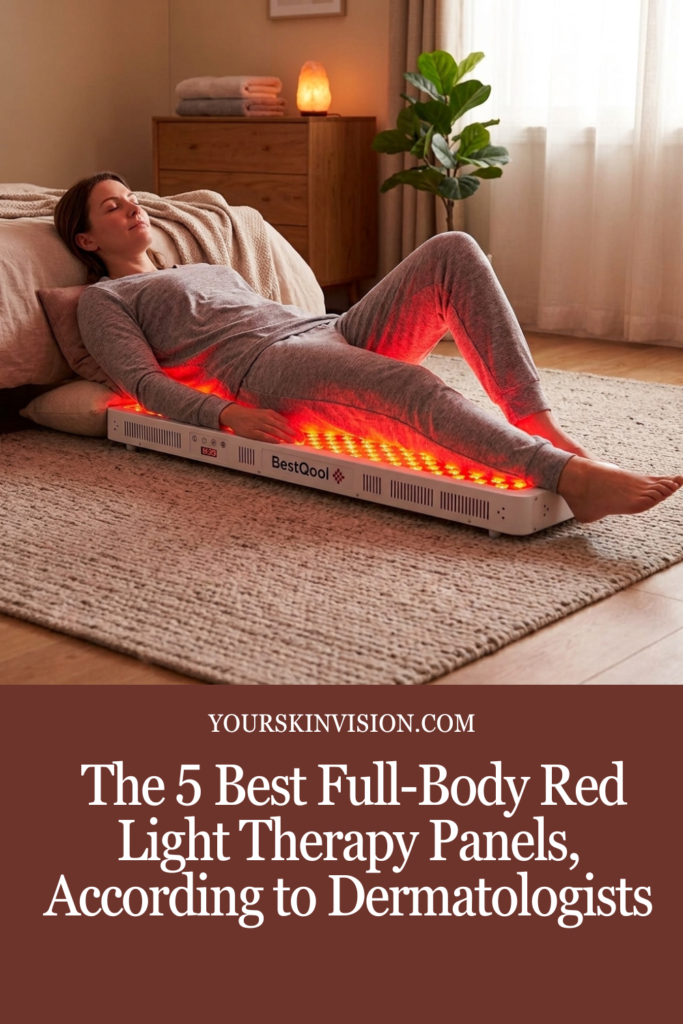
Table of Contents
What Makes a Red Light Therapy Panel Actually Work?
Not all red light devices earn their price tag. Dermatologist Dr. Dendy Engelman explains that the wavelength range matters more than flashy marketing claims. She recommends devices that combine 630-660nm red light for collagen stimulation with 810-850nm near-infrared light for deeper tissue penetration. Without both ranges, you only get surface-level benefits.
Power output matters just as much. A panel needs enough irradiance to actually change something at the cellular level. Weak devices might feel nice and warm, but they won’t do much for fine lines, muscle recovery, or inflammation. Dermatologists suggest looking for at least 100 mW/cm² for full-panel treatments, measured close to the skin.
Also, size counts. A full-body panel needs enough surface area to treat your back, legs, or chest without constant repositioning. Otherwise, you’re basically buying a face device and hoping it stretches further than it should.
Session length and consistency finish the equation. Most experts recommend 10 to 20 minutes per session, three to five times a week. Skipping sessions or expecting overnight miracles sets you up for disappointment, because red light therapy works through gradual cellular changes, not instant transformation.
How Did We Choose These Full-Body Red Light Panels?
We didn’t just grab whatever showed up first on Amazon’s search results. Instead, we cross-checked wavelength accuracy, irradiance strength, build quality, and genuine customer feedback across multiple independent sources and verified Amazon listings.
We also leaned on published commentary from board-certified dermatologists, including Dr. Dendy Engelman, Dr. Michelle Henry, and Dr. Purvisha Patel, all of whom have spoken publicly about what separates a legitimate therapeutic device from a gimmick. Their guidance shaped which products made this list and why.
Every panel below ships and sells on Amazon, comes from a full-body category (not a small handheld wand or a face-only mask), and has a track record of real buyer reviews. We ranked the overall best pick first, then moved through strong runner-ups for different needs and budgets.
What Are The Best Full-Body Red Light Therapy Panels You Can Buy

1. BestQool Pro200 — Best Overall Full-Body Panel
The BestQool Pro200 tops this list because it checks every box dermatologists care about. It uses four wavelengths (630nm, 660nm, 810nm, and 850nm), covering both collagen-boosting red light and deeper-penetrating near-infrared light in a single device. That combination gives you flexibility for skin concerns, muscle recovery, and joint discomfort without switching devices.
At 340W with 200 elite-grade dual-chip LEDs, the Pro200 delivers clinical-level irradiance close to what you’d find in a professional treatment room. Because it’s a full-panel design, you don’t need to angle a small device toward different body parts awkwardly. You simply stand in front of it.
Dr. Michelle Henry has pointed out that consistency, not intensity alone, drives results with red light therapy. The Pro200 makes consistency easy, since its size lets you treat your whole torso, arms, or legs in a single session instead of multiple rounds.
Real buyer experience: One verified Amazon reviewer, a 42-year-old teacher from Texas, said she started using the Pro200 for lower back pain after long days standing in her classroom. Within three weeks, she reported noticeably less stiffness in the evenings and mentioned that her skin looked “less dull” as a bonus. Another buyer, a personal trainer in Ohio, uses the panel after workouts and says his recovery time between heavy leg days improved once he made it a daily habit instead of an occasional treat.
Why it wins: Strong irradiance, four wavelengths, and true full-body coverage make this the safest first purchase for most buyers. It costs more than beginner panels, but the output justifies the price.

2. Hooga ULTRA1500 — Best Flagship Full-Body Panel
If the Pro200 is the smart everyday choice, the Hooga ULTRA1500 is the upgrade for people who want maximum output and don’t mind paying for it. Hooga built this as its flagship full-body panel, using 300 quad-chip LEDs that emit four wavelengths: 630nm, 660nm, 810nm, and 850nm.
Because it uses quad-chip technology, the ULTRA1500 pushes higher irradiance than most panels in its size class. That means shorter sessions can still deliver a therapeutic dose, which matters if you’re busy or simply don’t want to stand still for twenty minutes every day.
Dr. Purvisha Patel notes that near-infrared wavelengths carry real anti-inflammatory benefits, especially for people managing chronic skin conditions or slow-healing areas. The ULTRA1500’s dual-wavelength depth makes it a strong pick for anyone dealing with more than just cosmetic concerns.
Real buyer experience: A nurse in Florida who works long overnight shifts said she bought the ULTRA1500 mainly for her lower legs, which swell after twelve-hour shifts. She noticed reduced puffiness after about a month of near-daily use. A second reviewer, a retired construction worker in Pennsylvania, mentioned using it for chronic shoulder pain and said the sessions became “the one part of his day where he actually sits still,” which he half-jokingly credits for helping just as much as the light itself.
Why it wins: Higher irradiance and full quad-wavelength coverage make this the strongest performance pick on the list, ideal for people who want faster sessions without sacrificing power.

3. LifePro BioHeal Red Light Panel — Best for Beginners
Not everyone wants to spend hundreds of dollars before knowing whether red light therapy actually works for them. The LifePro BioHeal Panel solves that problem. It uses a straightforward dual-wavelength setup (660nm red and 850nm near-infrared) through 90 to 120 dual-chip LEDs, and it comes with a hanging kit and protective eyewear included.
Because LifePro built its reputation on fitness recovery tools like massage guns and vibration plates, the brand designed this panel with simplicity in mind. You get one button, clear settings, and a panel light enough to move between rooms.
Dr. Dendy Engelman often reminds beginners that the two most heavily studied wavelengths, 660nm and 850nm, cover most of what people actually want from red light therapy: better skin tone and reduced muscle soreness. You don’t need six wavelengths to get real benefits, especially when starting.
Real buyer experience: A stay-at-home mom in Georgia said she started using the panel each morning for ten minutes on her face and neck, then switched to her lower back after gardening. She described her skin as “brighter” within a few weeks. Another buyer, a college athlete in California, uses it post-practice and says his post-game soreness dropped noticeably once he committed to using it four times a week instead of randomly.
Why it wins: It’s affordable, beginner-friendly, and still uses clinically relevant wavelengths, making it the easiest entry point for someone testing red light therapy for the first time.

4. Makiuri Neptune Full-Body Panel — Best for Maximum Wavelength Range
The Makiuri Neptune stands out because it goes beyond the standard two-wavelength setup. It combines five wavelengths (630nm, 660nm, 810nm, 830nm, and 850nm) across 300 LEDs, giving you a broader therapeutic range in a single full-body session.
Because it covers more of the light spectrum, the Neptune appeals to people managing multiple concerns at once, like skin texture, joint pain, and circulation. Instead of buying separate devices, you get more flexibility from one panel.
Experts who study photobiomodulation often point out that different wavelengths penetrate skin to different depths. A wider spread means you’re more likely to hit the exact depth needed for whatever you’re treating, whether that’s a surface wrinkle or a deeper muscle knot.
Real buyer experience: A yoga instructor in Colorado said she originally bought the Neptune for hip and lower back tightness from years of teaching, but noticed her chest and neck skin also looked smoother after two months of regular use. Another reviewer, a home office worker in North Carolina managing chronic neck tension, said the wider LED spread let him treat his shoulders and upper back at the same time, which shorter panels couldn’t do.
Why it wins: The five-wavelength design offers more versatility than most competitors, which makes it a strong pick for people who want one device to handle several concerns.

5. Bontanny BO-1200 — Best Budget-Friendly Modular Option
Rounding out the list, the Bontanny BO-1200 offers 224 dual-chip clinical-grade LEDs across five wavelengths (630nm, 660nm, 810nm, 830nm, and 850nm), along with a remote control and built-in timer. It costs less than most premium panels, yet it still hits the wavelength and LED-density benchmarks dermatologists recommend.
Because it includes a remote, you can adjust settings from across the room instead of walking up to the panel every time. That small design choice makes daily use noticeably easier, especially if you’re treating your back or legs and can’t reach the controls comfortably.
Dermatologists generally agree that people stick with skincare tools they find convenient. A remote-controlled timer removes one more excuse to skip a session, which matters more than people expect when building a consistent routine.
Real buyer experience: A warehouse worker in Michigan said he bought the BO-1200 for chronic knee pain from years of physical labor and found the remote control especially useful since kneeling to adjust settings wasn’t comfortable. Another buyer, a new mom in Illinois recovering from a C-section, mentioned using the lower wavelength setting on her abdomen and noticing less scar tenderness over several weeks of gentle, consistent use.
Why it wins: It delivers real wavelength coverage and decent LED density at a friendlier price point, making it a smart budget pick without cutting corners on the fundamentals.
How Should You Use a Full-Body Red Light Panel for Best Results?
Buying the right panel only gets you halfway there. How you use it determines whether you see real results or just a warm glow with nothing to show for it.
First, stay consistent. Dermatologists recommend three to five sessions per week, and skipping around won’t give your cells enough repeated exposure to trigger meaningful change. Because red light therapy works through cumulative cellular signaling, sporadic use rarely produces visible results.
Second, respect the distance guidelines. Sitting too close can overexpose your skin and cause sensitivity, while sitting too far reduces the dose your body actually receives. Most panels recommend 6 to 12 inches, so check your specific device’s instructions.
Third, protect your eyes. Direct exposure to bright red and near-infrared light can strain your eyes over repeated sessions, so use the included eyewear if your panel comes with it.
Finally, pair red light therapy with good basics. It won’t replace sunscreen, hydration, sleep, or a solid skincare routine, but it can genuinely enhance the results you’re already working toward.
What is the Difference Between a Red Light Mask and a Panel?
The biggest difference between a red light mask and a red light therapy panel is the area they treat and how they deliver light. A red light mask is designed specifically for the face. It sits close to the skin, making it convenient for targeting fine lines, wrinkles, acne, and uneven skin tone. Most masks use red and sometimes near-infrared light, but they only cover the face (and occasionally the neck).
A red light therapy panel is much larger and more versatile. It can treat the face, neck, chest, back, joints, or even the entire body, depending on its size. Panels are commonly used for skin rejuvenation as well as muscle recovery, joint discomfort, and general wellness. Because they cover a larger area, they are often a better choice if you want one device for multiple purposes.
Final Thoughts
Red light therapy isn’t magic, but it isn’t hype either. When you pick a panel with the right wavelengths, strong enough output, and real full-body coverage, you give your skin, muscles, and joints a legitimate tool for recovery and repair.
The BestQool Pro200 remains the strongest all-around choice for most people, thanks to its balance of power, wavelength range, and true full-body design. However, your ideal pick depends on your budget, your goals, and how much coverage you actually need.
Whichever panel you choose, give it time. Real results build slowly, session by session, and the people who stick with it are usually the ones who end up recommending it to everyone else.
