
Your hair starts thinning, and you have tried everything, including new shampoos, vitamins, and serums. You Google endlessly. You stress about it, which probably makes it worse. Sound familiar?
Here’s something most people don’t know: light can actually stimulate your scalp at the cellular level. Red light therapy, also called low-level laser therapy (LLLT), works by boosting circulation and waking up sluggish hair follicles.
The FDA has cleared several of these devices for hair loss treatment, and dermatologists across the U.S. are now recommending them to patients seeking results without a prescription. This article breaks down the five best red light therapy devices for hair loss, ranked from best to good, so you can pick the one that works for your budget and scalp.
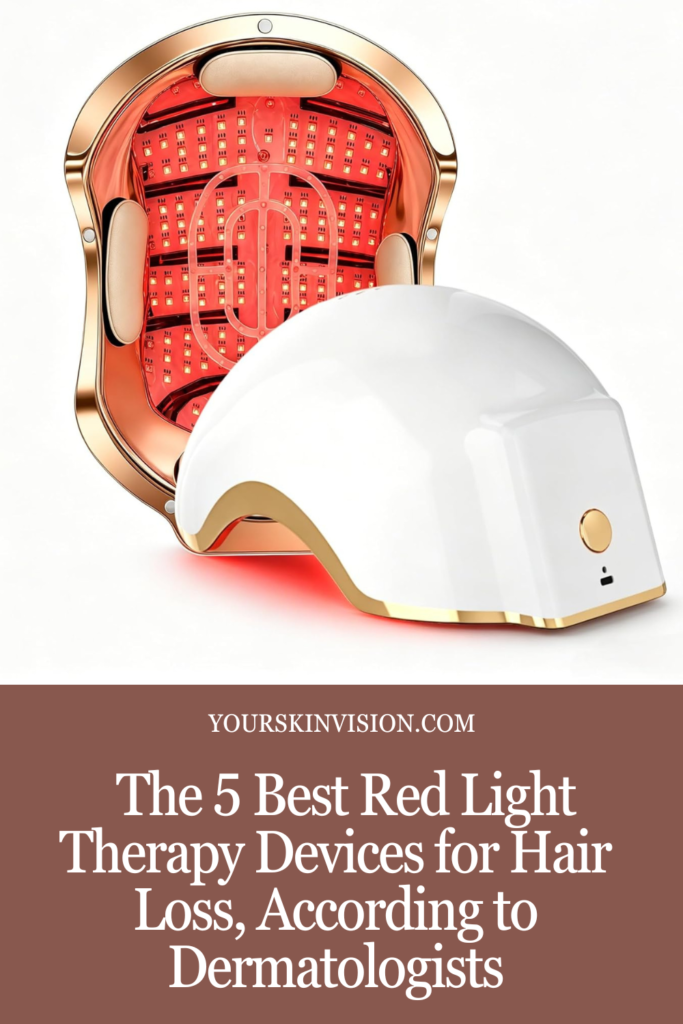
Table of Contents
What Is Red Light Therapy and How Does It Actually Work for Hair Loss?
Red light therapy isn’t a new concept. Scientists first noticed its effects on hair growth back in the 1960s, almost by accident. Today, dermatologists use it as a legitimate, non-invasive treatment for androgenetic alopecia, which is just the clinical name for common pattern hair loss in both men and women.
The devices emit wavelengths between 630 and 680 nanometers. Those wavelengths reach the hair follicle and stimulate something called the mitochondria inside your cells. When the mitochondria absorb that red light, they produce more energy. That energy jumpstarts the follicle out of the resting phase (called telogen) and nudges it back into active growth (called anagen).
A board-certified dermatologist said: “Red light therapy increases blood flow to the scalp, delivering more oxygen and nutrients to dormant follicles. That’s what drives new hair growth. The key is consistency. Patients who skip sessions don’t see the same results.”
At-home devices bring this technology out of the clinic. Most require three to five sessions per week, with each session lasting anywhere from eight to twenty minutes. Results typically show up between three and six months in. It’s not a quick fix, but it’s one of the few non-surgical approaches with solid clinical backing.
Which Red Light Therapy Device Works Best for Hair Loss?

1. iRestore Elite Laser Hair Growth System — Best Overall
Who it’s for: Anyone serious about hair regrowth who wants the most clinically backed at-home option
The iRestore Elite sits at the top of this list for good reason. It combines 500 laser diodes and LEDs inside a helmet-style design that covers your entire scalp at once. That full-scalp coverage is the biggest reason dermatologists keep recommending it. You get consistent, uniform light exposure from your hairline all the way to your crown, no hot spots, no missed patches.
The device uses 650nm red laser diodes and 630nm LEDs. Both wavelengths fall in the proven therapeutic range. FDA clearance backs it up for hereditary hair loss in both men and women. Sessions run just 25 minutes, and the device turns itself off automatically when the timer ends.
What real users say:
“I started using the iRestore Elite after my dermatologist recommended it. I was skeptical; I’d already tried minoxidil and saw limited results. After four months of using this three times a week, I noticed baby hairs coming in along my temples. My husband noticed before I did, honestly. The coverage feels complete, not like you’re just zapping one spot.” — Sarah K., 38, from Portland, Oregon
“I’ve been dealing with thinning at the crown since my mid-forties. The iRestore Elite is pricey, but I’ve tried cheaper alternatives that did nothing. This one, combined with my dermatologist’s recommendation to stay consistent, actually gave me visible results by month five. I’m not going to pretend it’s magic, but my hair density has clearly improved.” — Marcus T., 51, from Atlanta, Georgia
Pros: Full-scalp coverage, FDA-cleared, hands-free design, automatic timer. Cons: High price point, bulky to store

2. OVEKPA Red Light Therapy Laser Cap — Best Laser Cap Design
Who it’s for: People who want a discreet, wearable option they can use anywhere
The OVEKPA Red Light Therapy Laser Cap offers a simple, hands-free way to support hair regrowth without leaving home. Designed for both men and women, this FDA 510(k)-cleared device uses advanced low-level laser therapy (LLLT) to help improve the appearance of thinning hair, receding hairlines, and alopecia. Its non-invasive design provides a drug-free option for people looking to strengthen their hair over time.
Unlike handheld hair growth devices, this laser cap delivers full-scalp coverage in a comfortable helmet-style design. It evenly directs laser energy across the hairline, temples, crown, and other areas where hair thinning is most noticeable, allowing you to enjoy consistent treatment without constantly moving the device.
Another standout feature is its cordless operation. The built-in rechargeable battery lets you complete treatments almost anywhere, whether you’re relaxing at home, reading, or catching up on work. An easy-to-read battery indicator shows the remaining power and alerts you when it’s time to recharge, making everyday use more convenient.
The cap includes both continuous and pulse treatment modes, giving you flexibility to personalize your sessions. When used every other day for around 30 minutes, many users begin seeing visible improvements in hair fullness and thickness after several months of consistent use.
“Wearability increases compliance. When a device is discreet and fits into your daily routine, patients actually use it consistently, and consistency is everything with LLLT. The OVEKPA Red Light Therapy Laser Cap design removes a big barrier for a lot of people.”
What real users say:
“I bought this because I travel constantly for work and needed something I could pack easily. The cap folds down and fits in my carry-on. I’ve been using it for six months now, and the thinning at the top of my head has noticeably slowed. I’d say I have more coverage now than I did a year ago.” — James R., 44, from Dallas, Texas
“The discreet design sold me. I live with roommates and didn’t want to walk around wearing something that looks like a medical device. The OVEKPA Red Light Therapy Laser Cap just looks like a regular hat. Five months in, my stylist commented that my hair looked thicker. That was all the proof I needed.” — Alicia M., 29, from Chicago, Illinois

3. HairMax LaserBand 82 ComfortFlex — Best for Speed and Ease
Who it’s for: Busy people who want fast sessions and a simple routine
The HairMax LaserBand 82 works differently from the cap or helmet options. You glide it across your scalp in three positions, ninety seconds each, for a total treatment time of just 90 seconds per section. The full session takes less than three minutes. For anyone who struggles to commit 20 to 30 minutes per session, this format removes that obstacle entirely.
The 82 laser diodes part your hair as you move the band, which lets the light reach the scalp directly. HairMax has been in the LLLT space longer than almost any other brand; over 20 years of clinical research backs their technology. This device carries FDA clearance and has seven published clinical studies supporting it.
Dr. Jerry Shapiro, a clinical professor of dermatology at NYU Langone Health, has spoken on the subject directly: “HairMax has more clinical studies behind it than most at-home laser devices. The parting teeth design is smart; getting light through the hair to the actual follicle is where a lot of devices fail. The LaserBand solves that problem.”
What real users say:
“I’m a nurse, and I work 12-hour shifts. I don’t have 30 minutes to sit around with a helmet on. The LaserBand 82 fits into my morning routine because I can do it while standing at the bathroom mirror. I’ve been using it for about five months, and the shedding has decreased a lot. My hair feels fuller overall.” — Tanya B., 35, from Phoenix, Arizona
“I was really doubtful about something that only takes three minutes. Laser therapy always seemed like it needed more time to work. But the science makes sense: 82 diodes at the right wavelength is 82 diodes regardless of whether you spend 3 minutes or 30. Eight months in, I can say it works. My hairline came back in a spot where I was pretty sure it was gone for good.” — Derek W., 47, from Seattle, Washington
Pros: Ultra-fast sessions, parting teeth for direct scalp access, 7+ clinical studies, FDA-cleared Cons: Requires manual movement across scalp, not hands-free

4. Theradome EVO LH40 Laser Helmet — Best Mid-Range Helmet
Who it’s for: People who want a helmet design at a lower price than the iRestore Elite
The Theradome EVO LH40 uses 40 laser diodes at a clinical-grade wavelength of 680nm. That wavelength sits slightly higher than most competitor devices, and Theradome says it penetrates deeper into the scalp tissue. The helmet design covers the top of your head and runs for 20 minutes automatically before shutting off.
Theradome was the first company to get FDA clearance for a wireless laser helmet worn at home. That history matters because it means years of real-world use data and peer-reviewed research support the device. The EVO model updates the original design with better coverage and comfort.
What real users say:
“I chose the Theradome over pricier options because the 680nm wavelength made sense to me after researching. It penetrates deeper, and I felt like that was worth the trade-off on the number of diodes. Six months in, my hair is growing back in an area near my temples where thinning had been progressing for three years. I’m genuinely surprised.” — Robert L., 52, from Nashville, Tennessee
“I’m a naturally skeptical person, so I read all the studies before buying. The Theradome has legit clinical backing. The helmet is comfortable, the sessions are 20 minutes, which I use for morning news, and I’ve seen real improvement in my overall hair density. It’s been eight months. I’ll keep using it.” — Christine P., 41, from Boston, Massachusetts
Pros: 680nm deep-penetrating wavelength, FDA-cleared, wireless design, well-researched Cons: Fewer diodes than premium models, coverage doesn’t extend to temples as well

5. DRTHEORY Hair Growth Device — Best Budget Option
Who it’s for: People who want to try LLLT without spending hundreds on a premium brand
The DRTHEORY Hair Growth Device is a convenient at-home solution for men and women looking to improve the appearance of thinning hair. FDA-cleared for androgenetic alopecia, this wearable device uses clinically tested low-level laser therapy (LLLT) with 162 laser diodes operating at 650–660 nm to support healthier-looking, fuller hair over time.
The laser diodes are carefully positioned throughout the helmet to provide even coverage across the scalp. This allows the device to deliver consistent light therapy to key areas commonly affected by hair thinning, including the hairline, temples, sides, and crown. The comfortable inner lining and lightweight design make it suitable for regular treatment sessions.
Using the device is simple and requires very little effort. With the press of a button, it automatically starts a 20-minute treatment and powers off when the session is complete. Because it is cordless and powered by a rechargeable battery, you can comfortably wear it while reading, working, watching television, or relaxing at home without being tied to a power outlet.
The built-in airflow system helps improve comfort during use, while the indicator lights clearly display charging and operating status. For the best results, the manufacturer recommends using the device indoors two to three times each week as part of a consistent hair care routine.
What real users say:
“I wasn’t ready to spend $600 on a laser helmet without knowing if this technology even works for me. The DRTHEORY Hair Growth Device let me try it for a fraction of the price. After four months, I saw enough improvement that I now believe in the technology. I might upgrade later, but this got me started, and I don’t regret it.” — Lauren F., 33, from Austin, Texas
“My main concern was whether a budget device could actually deliver enough light energy. Honestly, it held up. The build quality isn’t premium, but the diodes work, and the coverage is solid. Seven months in, I have noticeably more hair on the crown. I’ll take that result at any price.” — Anthony G., 45, from Miami, Florida
Pros: Affordable entry point, 162 diodes, full-head coverage, automatic timer. Cons: Fewer clinical studies, lower build quality than premium brands
How Do You Know If a Red Light Therapy Device Will Actually Work for You?
This is the question that trips most people up. Not every hair loss situation responds the same way to red light therapy. LLLT works best for androgenetic alopecia, pattern baldness. It also shows promise for alopecia areata and hair loss caused by stress or illness.
However, if hair follicles are completely dead and the scalp shows scar tissue, LLLT can’t reverse that. No device can. The follicle needs to still be alive, even if dormant, for light therapy to help. Your age matters too. Younger follicles respond faster. People in their 30s and early 40s tend to see results sooner than people in their 60s and beyond, though older users still see improvement with consistent use.
Consistency is the biggest factor regardless of the device you choose. Most clinical studies require three to five sessions per week over six months to show measurable results. Skip sessions regularly, and you slow down the process significantly.
Dr. Michele Green reinforces this: “I tell my patients to treat red light therapy like exercise. Missing one session won’t ruin your progress. Missing sessions every week absolutely will. The photobiomodulation process needs regular stimulation to maintain momentum.” Look for these signs that a device is worth your investment:
- FDA clearance — Not just “FDA registered.” Clearance means clinical data was reviewed.
- Clinical wavelengths — Devices should emit between 630nm and 680nm. Outside that range, the evidence is weaker.
- Diode count — More diodes generally mean better coverage and faster sessions.
- Brand history — Companies with multiple clinical studies are more reliable than newcomers with only marketing claims.
Also, consider combining red light therapy with other proven treatments. Minoxidil (Rogaine) and red light therapy together often produce better results than either approach alone. Talk to your dermatologist before starting any combination treatment plan.
Conclusion
Red light therapy is one of the few non-surgical hair loss treatments with real science behind it. The five devices above cover every budget and lifestyle, from the fully loaded iRestore Elite to the affordable DRTHEORY Hair Growth Device.
If budget isn’t a concern, go with the iRestore Elite. If you travel or value discretion, the OVEKPA Red Light Therapy Laser Cap is the smarter pick. Short on time? The HairMax LaserBand 82 handles sessions in three minutes. Want a solid mid-range option? The Theradome EVO delivers deep-penetrating wavelengths at a lower cost. Just starting? The DRTHEORY Hair Growth Device gives you a low-risk entry point.
Whatever you choose, stick with it. Give the device at least four to six months before judging whether it’s working. Results in this space are real, but they’re also slow. Patience, plus consistency, is what separates people who see results from people who return their devices after 30 days. Your follicles are still fighting. Give them the right tools.
