
Dry aging skin presents a compounding challenge that neither “dry skin” products nor “anti-aging” products address fully on their own. Aging skin loses collagen, which thins the dermis and makes the skin structurally fragile.
Dry skin loses ceramides and sebum, which compromises the barrier and accelerates moisture loss. When both happen simultaneously, as they do in most people from their mid-forties onward, the skin becomes both thin and dry, fragile and dehydrated, prone to irritation and prone to fine lines simultaneously.
A cleanser designed purely for dryness may include emollients that sit too heavily on aging skin’s reduced follicular activity. An anti-aging cleanser with AHA exfoliation or active treatments may be too aggressive for a dry, depleted barrier. Dermatologists navigate this intersection precisely. This article covers the best cleansers for dry aging skin that they actually recommend, all on Amazon.
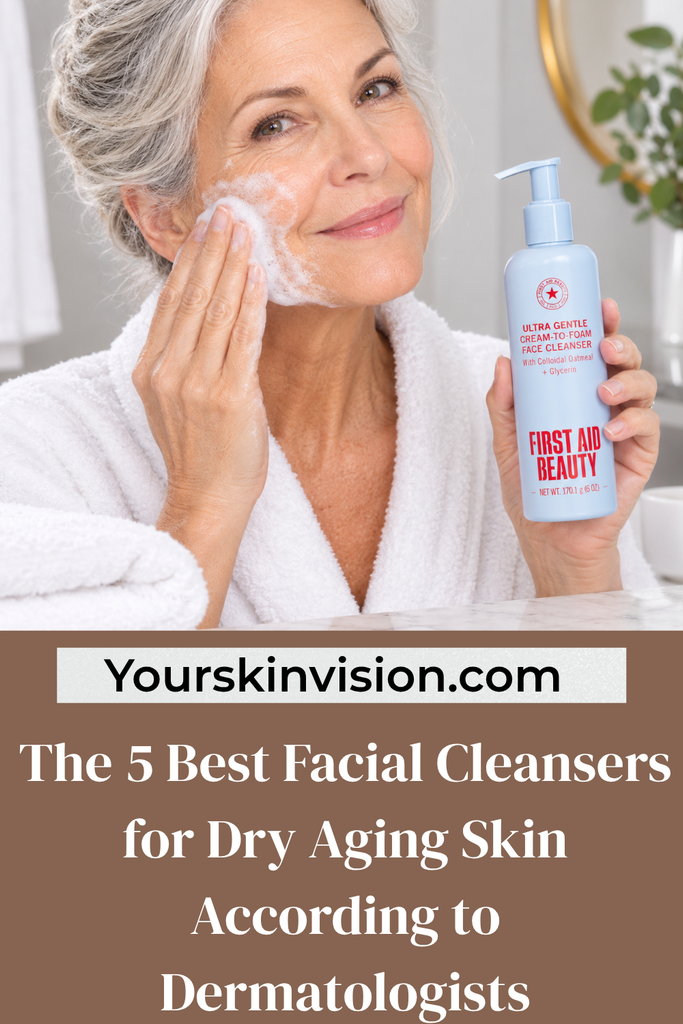
Table of Contents
This Is What Dermatologists Say About the Specific Needs of Dry Aging Skin Versus Other Dry Skin Types
Dry aging skin is clinically distinct from young dry skin, and dermatologists approach it through a lens that accounts for both the structural changes of aging and the barrier dysfunction of chronic dryness simultaneously.
Board-certified dermatologist Dr. Patricia Farris, clinical associate professor of dermatology at Tulane University School of Medicine and a widely cited expert in NewBeauty and Dermatology Times, explains that dry aging skin presents a dual vulnerability that each condition amplifies in the other.
The collagen loss of aging reduces the dermis’s structural density, making it thinner and more vulnerable to the water loss that dry skin already struggles with. Meanwhile, the barrier dysfunction of dry skin allows irritants to reach the collagen-producing fibroblasts more readily, triggering the inflammatory responses that dermatologists now recognize as a primary driver of accelerated collagen degradation.
This dual vulnerability creates specific needs for dry aging skin’s cleanser that differ from purely dry or purely mature skin:
- Gentle but effective; no compromise — dry aging skin needs a cleanser gentle enough for a compromised barrier but effective enough to remove the SPF that dermatologists consider essential for preventing further photoaging-driven collagen loss. These requirements conflict in most standard formulations; effective SPF removal often requires surfactant concentrations too high for dry aging skin’s barrier.
- Active anti-aging ingredients alongside cleansing — the cleanser step provides a daily opportunity to deliver niacinamide, peptides, or ceramides to the aging, depleted skin during the contact period, turning a necessary step into a productive one. Dermatologists recommend cleansers that contribute to skin improvement rather than simply maintaining the status quo.
- No exfoliating actives in the cleanser — while exfoliation is important for dry aging skin’s slower cell turnover, dermatologists consistently recommend keeping exfoliating actives (AHAs, BHAs, retinol) in leave-on formulas where contact time is controlled. An exfoliating cleanser on dry aging skin risks barrier disruption that the compromised lipid structure cannot adequately repair.
- pH 4.5 to 5.5 — dry aging skin’s natural pH becomes more alkaline with age, making pH-balanced cleansers particularly important. High-pH cleansers deactivate the barrier’s protective enzymes and create the alkaline environment that accelerates the collagen degradation dermatologists are trying to prevent.
- Lipid-restoring ingredients — ceramides, squalane, and fatty acids in the cleanser formula partially replace the lipids that aging skin’s reduced sebum production and depleted ceramide synthesis can no longer supply from within.
5 Facial Cleansers Dermatologists Rank as the Overall Best for Dry Aging Skin?

1. Overall Best: CeraVe Hydrating Facial Cleanser
CeraVe Hydrating Facial Cleanser earns the top dermatologist recommendation for dry aging skin because it uniquely addresses both sides of the dual vulnerability, repairing the ceramide barrier that dry skin has depleted while delivering ingredients that support the structural skin quality that aging has diminished. No other accessible cleanser combines these two functions as effectively through a single daily formula.
The three ceramides in the MVE (MultiVesicular Emulsion) system release gradually throughout the day following morning or evening application, addressing the continuous moisture loss that dry aging skin experiences between cleanses rather than providing a single burst of ceramide delivery that depletes quickly.
Dermatologists point to this sustained release as particularly meaningful for aging skin, whose reduced repair capacity means that single-dose barrier support from a standard cleanser wears off before the next cleanse.
Hyaluronic acid draws moisture into surface cells during the cleansing contact period, plumping the fine dehydration lines that form when aging skin’s moisture content falls. Niacinamide supports barrier function and reduces the inflammation that accelerates collagen breakdown in aging skin. The mild surfactant system removes SPF effectively enough for dermatologists to recommend it as a complete evening cleanser, without requiring a double-cleanse for SPF removal.
User Comments:
“My skin had become both visibly aging and very dry simultaneously, and nothing I tried addressed both at once. My dermatologist recommended CeraVe Hydrating Cleanser for the ceramide MVE technology specifically; she said the sustained ceramide release would address my dry skin’s barrier failure while the hyaluronic acid supported my aging skin’s hydration needs during each cleanse. After four months of evening use, my skin is noticeably softer, less reactive, and the fine lines around my eyes look less pronounced because the skin is better hydrated at the cellular level. This is the cleanser I recommend to every friend my age.”
“My dermatologist described my skin as ‘doubly depleted, ‘ with ceramides from dryness and collagen from age both declining simultaneously. She said CeraVe Hydrating Cleanser was the most appropriate daily cleanser because the ceramide delivery directly addressed one depletion while the formula’s niacinamide supported the collagen structure affected by the other. After six months of consistent use, my barrier feels measurably stronger, and my skin holds moisture better between my cleanse and my morning SPF. My dermatologist confirmed improvement at my last visit.”

2: La Roche-Posay Toleriane Hydrating Gentle Face Wash
La Roche-Posay Toleriane Hydrating Gentle Face Wash earns strong dermatologist recommendations for dry aging skin through a formula that addresses multiple skin aging concerns simultaneously, delivering niacinamide for barrier strengthening and anti-inflammatory benefit, thermal spring water minerals for active soothing of the vascular redness that becomes more visible as aging skin thins, and a mild surfactant system appropriate for dry skin’s compromised barrier.
Dermatologists recommend this for dry aging skin with concurrent redness or sensitivity, the combination of thinning skin that makes capillaries more visible and barrier dysfunction that makes skin reactive to irritants.
The thermal spring water’s documented anti-irritant properties directly address the increased vascular visibility of aging skin by reducing the inflammatory response that keeps dilated surface capillaries prominent.
The niacinamide addresses multiple aging concerns from within the cleanser step: it inhibits melanin transfer that creates age spots, strengthens the barrier that collagen loss has thinned, and reduces the sebum-regulating function that prevents the milia (small white bumps) that form in dry aging skin’s sluggish follicles.
User Comments:
“My dry aging skin had developed significant redness alongside the fine lines and dryness. My dermatologist said the thinning of my skin was making my capillaries more visible and that I needed a cleanser that calmed vascular reactivity alongside supporting my barrier. La Roche-Posay Toleriane was her recommendation for the thermal spring water’s active calming alongside the niacinamide barrier support. After three months of daily use, my redness has reduced visibly, and my skin feels genuinely more hydrated and resilient after cleansing than it ever did before.”
“My skin’s combination of dryness and visible aging had become my biggest skincare challenge. My dermatologist recommended La Roche-Posay Toleriane for the niacinamide; she said the consistent daily niacinamide exposure through the cleanser would address both the barrier weakness from dryness and the pigmentation irregularity from aging simultaneously. After five months, my skin tone is more even, my barrier is stronger, and the formula has never caused any irritation. The niacinamide through the cleanser step complemented my leave-on treatments perfectly.”

3: Neutrogena Healthy Skin Gentle Cleanser
Neutrogena Healthy Skin Gentle Cleanser earns dermatologist recommendations for dry aging skin through a formula that includes alpha hydroxy acid, at a concentration and rinse-off format that dermatologists consider appropriate for the gentle cell turnover support that aging skin needs without the barrier disruption that a full-concentration leave-on AHA would cause on dry, compromised skin.
Dermatologists recommend this specifically for dry aging skin where surface cell accumulation is visible, the thickened, uneven surface texture that forms when slower cell turnover leaves dead cells sitting on aging skin longer than they did at younger ages.
The AHA at low concentration in a rinse-off format provides enough cell turnover support to improve surface texture and allow subsequent skincare products to penetrate more effectively, without the extended acid contact that dry aging skin cannot tolerate.
The formula includes vitamin E and pro-vitamin B5 alongside the AHA, providing antioxidant and conditioning benefits that counteract the mild drying potential of the AHA component. Dermatologists recommend using this formula in the evening and applying a rich ceramide moisturizer immediately after to capitalize on the improved penetration the mild exfoliation creates.
User Comments:
“My dry aging skin had developed a dull, rough surface that made my moisturizers feel less effective; they sat on top rather than absorbing. My dermatologist said I needed mild cell turnover support in my cleanser but that my dry skin couldn’t tolerate a full AHA exfoliant. She recommended Neutrogena Healthy Skin Gentle Cleanser for the low-concentration AHA in a rinse-off format that provided just enough exfoliation to improve my surface texture without compromising my compromised barrier. After six weeks, my moisturizers absorb noticeably better, and my skin texture is smoother and more even.”
“My dermatologist described my surface skin texture as ‘stagnant’, too slow in cell turnover to renew effectively, which made my dry aging skin look dull and flat. She recommended a gentle AHA cleanser to restart the turnover without disrupting my dry skin’s barrier. Neutrogena Healthy Skin was her choice for the appropriate AHA concentration in a rinse-off format. After eight weeks of evening use followed by immediate ceramide moisturizer, my skin looks noticeably more radiant, and my texture has smoothed meaningfully. The gentle exfoliation support was the missing piece.”

4: Vanicream Gentle Facial Cleanser
Vanicream earns its position for dry aging skin specifically as the recommendation for patients whose dryness and aging have been complicated by the development of new contact sensitivities, a pattern dermatologists see frequently in patients whose dry, thinning aging skin has lost the barrier integrity needed to prevent allergen penetration.
Dermatologists explain that aging skin’s thinning stratum corneum and dry skin’s compromised lipid barrier work together to dramatically increase allergen penetration depth. Ingredients that sat harmlessly on healthy younger skin’s intact barrier now reach immune cells in the dermis more readily, triggering reactions that the patient correctly identifies as “my skin has become sensitive to things it used to tolerate.”
Vanicream’s comprehensive six-category allergen exclusion- fragrance, dyes, lanolin, parabens, formaldehyde releasers, botanical extracts- removes the triggers that aging dry skin has become newly sensitized to.
The sulfate-free surfactant system cleans without stripping. Together, these qualities make Vanicream the appropriate cleanser foundation for dry aging skin patients rebuilding their routine after a period of increased cosmetic reactions.
User Comments:
“By 61, my dry aging skin had started reacting to products I’d used for over a decade. My dermatologist explained that my thinning skin and compromised barrier were allowing ingredients to penetrate to immune cells they’d never reached before. She recommended Vanicream to eliminate all common allergens from my daily cleanse while my barrier recovered. Nine months without a cosmetic reaction is the longest I’ve gone in years. My skin has recovered enough barrier integrity that I’ve gradually reintroduced some of my previous products without problems.”
“The combination of aging and dryness had made my skin unpredictably reactive, a new problem I’d never dealt with in younger years. My dermatologist said both conditions together had created a barrier that could no longer screen out allergens adequately. Vanicream was her cleanser recommendation because it gave my depleted skin nothing to react to while I worked on barrier repair through my moisturizer. Four months of zero-reaction cleansing has allowed my barrier to improve enough that my skin is much less reactive overall. The foundation Vanicream provided made everything else in my routine work better.”

5: First Aid Beauty Pure Skin Face Cleanser
First Aid Beauty Pure Skin Face Cleanser earns dermatologist recommendations for dry aging skin through colloidal oatmeal, an FDA-recognized skin protectant that dermatologists recommend for aging skin specifically because it provides anti-inflammatory protection during the cleansing step alongside its moisture-retaining and barrier-protecting properties.
Dermatologists point to colloidal oatmeal’s specific relevance for aging skin: the chronic low-grade inflammation that dermatologists now call “inflammaging” inflammation-driven aging- accelerates collagen degradation in aging skin beyond what UV damage and chronological aging alone would cause.
Colloidal oatmeal’s clinically validated anti-inflammatory properties delivered during the cleansing step reduce the inflammatory burden on aging skin throughout the day, contributing to inflammaging reduction rather than just surface comfort.
The formula is fragrance-free, appropriate for dry skin’s reduced tolerance for fragrance-triggered reactions, and provides allantoin alongside colloidal oatmeal for additional skin-calming benefit. Dermatologists recommend this for dry aging skin patients with a component of inflammatory redness, chronic irritation, or eczema-like flares alongside the dryness and aging concerns.
User Comments:
“My dry aging skin had developed a chronic low-level inflammation, not a dramatic reaction, just persistent mild redness and irritation that seemed to underlie everything else. My dermatologist mentioned inflammaging as a real concern for accelerated collagen loss and recommended First Aid Beauty Pure Skin Cleanser for the colloidal oatmeal’s anti-inflammatory effect during the cleansing step. After three months of daily use, my baseline inflammation level has reduced noticeably. My dermatologist said the reduced inflammatory burden was protecting my remaining collagen more effectively than treatment after the fact.”
“I have eczema-prone skin that’s also showing signs of aging, a difficult combination where most anti-aging cleansers irritate my eczema, and most eczema cleansers don’t support aging skin. My dermatologist recommended First Aid Beauty for the colloidal oatmeal combination that addressed both an FDA-recognized skin protectant for my eczema and the anti-inflammatory inflammaging protection for my aging concern. After four months of consistent use, my eczema has stayed calmer, and my aging skin looks healthier overall. Finding one product that genuinely serves both needs has been a genuine relief.”
How Should People With Dry Aging Skin Cleanse to Get the Best Results?
Dry aging skin needs a cleansing approach that specifically accounts for both conditions, the barrier vulnerability of dry skin and the structural fragility of aging skin, simultaneously.
- Cleanse once daily with a full cleanser, morning water or micellar only. Dermatologists consistently recommend single daily surfactant cleansing for dry aging skin. Evening cleansing removes SPF and daily product residue where full cleaning is necessary. Morning cleansing with lukewarm water or gentle micellar water preserves the overnight barrier repair that dry aging skin’s slow recovery pace needs to maintain. This single change produces immediate daily comfort improvement for most dry aging skin patients.
- Prep dry skin before cleansing with a light facial oil or balm if wearing heavy SPF. For dry aging skin using high-SPF mineral sunscreens, which dermatologists strongly recommend, a brief oil or cleansing balm pre-cleanse applied to dry skin before the main cleanser dramatically improves SPF removal while protecting the barrier from the aggressive surfactant action that standalone removal of heavy mineral SPF requires. The oil dissolves the sunscreen film before the gentle cleanser emulsifies the oil, achieving full SPF removal without stripping.
- Use fingertips only; zero mechanical tools. Aging skin’s reduced collagen and elastin density means it has significantly less structural resilience than younger skin. A washcloth applied to aging skin creates lateral mechanical stress on a dermis that has lost its elasticity buffer. Fingertips at minimum pressure distribute and remove cleanser adequately without any mechanical stress that aging skin cannot recover from.
- Apply retinol or active treatments immediately after cleansing and before moisturizer. The cleansed, slightly damp skin surface of dry aging skin absorbs active ingredients most effectively in the first sixty seconds after cleansing, before the moisturizer creates any barrier to penetration. Dermatologists recommend applying retinol, peptide serums, or vitamin C during this sixty-second window to maximize active ingredient penetration into dry aging skin that otherwise absorbs poorly through its compromised surface.
- Finish with an occlusive layer over the moisturizer on extremely dry days. For dry aging skin in low-humidity conditions, dermatologists recommend finishing the evening routine with a light layer of petrolatum or squalane over the moisturizer, creating an occlusive seal that reduces overnight TEWL to its minimum possible level. This “slugging” approach for dry aging skin isn’t about adding more active ingredients; it’s about keeping what the cleanser and moisturizer have delivered inside the skin overnight.
Conclusion
Dry aging skin needs a cleanser that genuinely understands both conditions rather than addressing one at the expense of the other. The barrier support of ceramides, the anti-inflammatory protection of niacinamide and colloidal oatmeal, the mild surfactant chemistry appropriate for depleted skin, and the anti-aging awareness of what collagen loss does to the skin’s structural vulnerability- these qualities together define the formula that dermatologists reach for with dry aging patients.
CeraVe Hydrating Facial Cleanser earns the overall top recommendation because its ceramide MVE technology addresses the barrier depletion driving the dryness while its hydrating actives support the moisture quality that aging skin has structurally lost, turning a single daily cleanser into a genuine contribution to both conditions rather than a compromise between them.
Cleanse once daily in the evening with a full formula. Use micellar water or water only in the morning. Apply with fingertips only. Follow with active treatments in the first sixty seconds while skin is still slightly damp.
Then moisturize. That sequence, paired with the right formula, is what dermatologists recommend for dry aging skin that finally responds to a routine built specifically for its unique dual needs.
